

Dokra jewellery is not just another line of folk ornaments sold in India’s emporiums. But every time you see those lattice-like figurines or twisted brass bangles, you’re looking at the world’s oldest living metalcraft.
Dhokra art (another spelling for Dokra) has been practiced since the Indus Valley Civilisation—an uninterrupted tradition that’s lasted over 4000 years. That isn’t just trivia. It’s a living connection between what’s on your wrist and what once sat in the lost cities of Mohenjo-daro.
This isn’t an “origin story” that stops at a museum. Dokra’s method, motifs, and makers are still evolving. If you want to understand Indian jewellery, start with the craft that’s survived every empire and trend: Dokra. Here’s how it works, why it matters, and why every piece is both ancient and new.

Why Dokra Survived While Other Metalcrafts Faded
Most traditional crafts have faded, adapted out of existence, or become locked in glass cases. Dokra is different—it’s still worn, bought, and made today. The reason? Adaptability rooted in method.
“Dhokra art has been practiced for over 4000 years.”— Live History India
Four things have kept Dokra not just relevant, but alive:
- Portable Technique: The lost-wax method (more on this below) doesn’t need heavy machinery, urban workshops, or mass production. Artisans can (and do) move with their tools.
- Versatility: Dokra is more than jewellery—artisans make figurines, utensils, deities, and home decor. If a product sells, the craft adapts.
- Regional Variation: The Dhokra Damar tribe is most famous, but the technique thrives across West Bengal, Chhattisgarh, Odisha, Telangana, and Jharkhand. Each region evolves its own style.
- Cultural Significance: In many tribal and rural areas, Dokra pieces aren’t just for decoration—they’re sacred, used in weddings, births, even local justice rituals.
Think of it like seed banks for ancient grains: Dokra survives because it can grow almost anywhere, and serves many needs.
How Lost-Wax Casting Makes Each Piece Truly Unique
The secret behind Dokra’s charm—and its survival—is the lost-wax (cire perdue) technique. This is not just “how it’s made”; it’s why you’ll never find two Dokra pieces exactly alike.
Step-by-Step: Traditional Lost-Wax Casting
-
Creating the Core:
- Artisans shape a core from river clay, roughly in the shape of the final object.
-
Wax Modelling:
- They cover the clay with a layer of beeswax, rolling and shaping every tiny detail (beads, lines, patterns).
-
Applying the Outer Clay:
- Another layer of clay covers the wax—this will act as the mold.
-
Firing:
- The mold is fired in open ground kilns. The wax melts away (“lost” wax), leaving a gap between the two clay shells.
-
Pouring the Metal:
- Molten brass is poured in, filling the space left by the vanished wax.
-
Breaking the Mold:
- Once cool, the outer clay shell is broken—destroyed forever—revealing the metal piece.
If you’re imagining this like a factory line, stop. Each mold is one use only; each wax detail is made anew.
Dokra vs. Other Traditional Metalcrafts
| Feature | Dokra (Lost-Wax) | Bidriwork | Kundaikattu (South India) |
|---|---|---|---|
| Main Metal | Brass/Bronze | Zinc | Bronze |
| Mold Type | Clay + Wax (destroyed) | Metal (reusable) | Clay-sand composite |
| Finish | Textured, grainy | Smooth, inlay | Polished, sometimes inlay |
| Replicability | No exact duplicates | Possible | Limited |
| Motifs | Tribal/animal/human | Geometric/floral | Deity, ritual objects |
Dokra’s uniqueness is technical and aesthetic. No artist can exactly copy another’s work, so every piece comes with its own fingerprint.
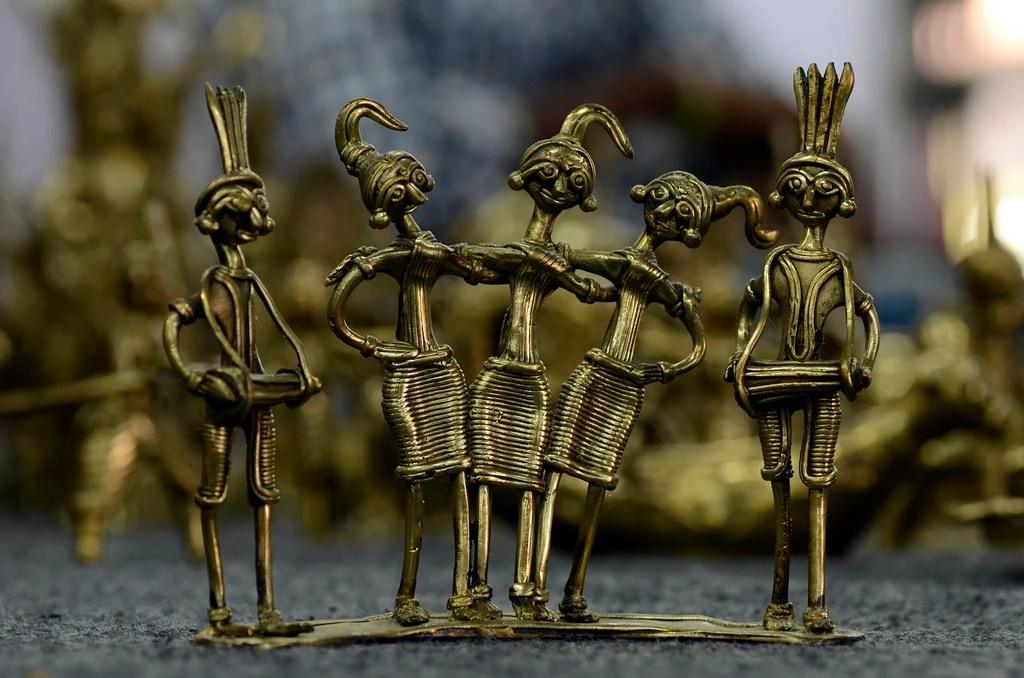
The Dhokra Damar Tribe: Guardians and Innovators
If you trace Dokra’s story as far as it goes, you wind up with the Dhokra Damar tribe—who’ve effectively kept this craft alive across millennia.
Who Are the Dhokra Damar?
- Originally semi-nomadic metalworkers, spreading through present-day West Bengal, Chhattisgarh, Odisha, and Telangana.
- Still a distinct social group, with their own rituals, apprenticeship traditions, and artistic canons.
- Most families work from home workshops, often with children learning from as young as age eight.
Their method is old, but their survival is modern: Dhokra artisans have gotten Geographical Indication (GI) status in 2018, and UNESCO added Dhokra to India’s list of intangible heritage.
“Dhokra received its Geographical Indication in 2018 and has also been recognised as an intangible heritage by UNESCO.”— Oaklores
The Dhokra Damar Tribe

The Modern Artisan: Between Tradition and Necessity
It’s not just about holding onto tradition. Many Dhokra makers are adapting:
- Combining traditional methods with gas kilns or electric melting pots where available.
- Making everything from animal figurines to custom logos for NGOs and brands who want “authentic” design.
- Participating in state-sponsored fairs, sending pieces to urban boutiques and export houses.
Most guides ignore the reality: Dokra’s survival relies as much on contemporary hustle as on heritage.

What Makes Dokra Jewellery Distinctive?
It’s tempting to call Dokra “tribal jewellery” and leave it there. But Dokra pieces aren’t just raw or rustic—they follow their own motifs, codes, and functions.
Core Features of Dokra Jewellery
- Iconic Motifs: Elephants, tortoises, dancing figures, peacocks, and goddess icons are recurring themes. Each has symbolic value—elephants for strength, tortoise for longevity, etc.
- Surface Texture: Instead of smooth polish, you get hand-twisted wires, granulated dots, and latticework that catches the light.
- Color: Authentic Dokra has a dull gold or muted bronze color—brighter finishes likely mean chemical treatment or machine-made fakes.
- Form: Bangles with spiral ends, pendants in bell shapes, earring hooks made in one with the ornament.
Table: Dokra Jewellery vs. Mass-Produced Brass Jewellery
| Feature | Dokra Jewellery | Mass-Produced Brass |
|---|---|---|
| Technique | Lost-wax casting | Machine-made, casting |
| Motifs | Animal, tribal, sacred | Generic patterns |
| Surface | Textured, uneven | Smooth, uniform |
| Color | Dull gold/bronze | Shiny, even finish |
| Weight | Heavier, variable | Lighter, standard |
| Price | Higher (per piece) | Lower, bulk rates |
| Uniqueness | No duplicates | Identical copies |
“No two pieces of Dhokra art are ever the same—that is the magic of the lost wax technique.”
It’s not just aesthetics. Every uneven line is proof of the maker’s hand.
Symbolism and Beliefs: Jewellery Beyond Ornament
Unlike most modern jewellery, Dokra is loaded with meaning. Motifs aren’t decorative—they serve cultural, sometimes spiritual, purposes.
Why These Motifs?
- Tortoise and Fish: Associated with longevity, fertility, and auspiciousness. Worn during marriages, housewarmings.
- Elephants and Horses: Power animals. Often combined with bells for kids’ anklets to channel protective energy.
- Human Figures (Dancers, Musicians): Seen in both jewellery and house idols—believed to bring joy and harmony.
Ritual Use
- Neckpieces gifted at tribal weddings as protective charms.
- Bracelet sets exchanged as vows among certain central Indian communities.
- Some pendants designed as locks (talismanic) to guard children from evil.
A mass-produced chain can’t replace the ritual significance woven into a single Dokra ornament.
From Indus Valley to 2026: A Timeline of Change
Dokra’s origins aren’t folklore—they’re archaeological fact. Tracing its evolution shows not just survival, but creative adaptation.
Major Milestones in Dokra Metalcraft
| Era | Event/Change |
|---|---|
| c. 2500-1800 BCE | Lost-wax “Dancing Girl” statue at Mohenjo-daro |
| Pre-1100 CE | Dokra spreads from Indus region into Central/East India |
| 16th–17th C | Dhokra Damar tribe mentioned in Mughal records |
| 19th–20th C | Colonial devaluation; Dokra shifted towards minor crafts |
| 1970s–80s | Revival: Museum and ethnographers rediscover technique |
| 2010s | Urban boutiques, international fairs, online sales begin |
| 2018 | GI status/UNESCO intangible heritage listing |
| 2020s | Artisans blend tech (gas kilns, e-commerce) with tradition |

Lost-wax “Dancing Girl” statue at Mohenjo-daro
The Hidden Economic Reality: Survival, Not Sentiment
While heritage stories attract buyers, the making of Dokra jewellery today is mostly about economic survival. For many craftspeople, it’s a means to feed families and educate children, not just preserve a tradition.
The Money Flow (Or Lack Thereof)
- Most artisans sell at local haats (markets) for modest sums—middlemen take a cut before products hit city boutiques.
- Production is labor-intensive (one necklace can take a week from start to finish), but prices don’t always reward effort.
- Export demand (especially from Europe and Japan) offers premium—but only for select, certified pieces.
Table: Typical Cost Breakdown for a Dokra Necklace
| Stage | % of Sale Price | Who Earns It |
|---|---|---|
| Raw Materials | 20% | Local suppliers |
| Artisan Labour | 30% | Craftspeople (family/tribe) |
| Middlemen | 30% | Traders/exporters |
| Retail Margin | 20% | Shops, galleries, online stores |
Many guides glamorize the jewelry, but the economics are simple: unless you seek out artisan-first programs or GI-registered sellers, the artist rarely benefits fully.
Identifying Authentic Dokra: What Sets It Apart?
With global interest rising, knockoffs and lookalikes flood physical and online markets. Knowing the differences can help buyers support the real art.
Quick Guide to Spotting Genuine Dokra Jewellery
- Surface Imperfections: Authentic pieces always have minor flaws—a mark of the hand.
- Weight Test: Real Dokra is often heavier and warmer to the touch than mass-made brass.
- Design Overlap: Don’t expect pairs to be identical—matched bangles aren’t mirror images.
- Natural Patina: Slightly mottled, non-uniform coloring. Too shiny usually means chemical polish.
- Certification: GI tags (in India) or documentation from recognized artisan collectives.
Telltale Signs of Real vs. Fake Dokra
| Feature | Real Dokra | Fake/Replicas |
|---|---|---|
| Texture | Raw, uneven | Smooth, machine-finished |
| Weight | Heavy, solid | Lightweight, tinny |
| Markings | Small pitting, joints | Perfect lines |
| Pair Similarity | Slight differences | Identical pairs |
| Patina | Dull/muted | Glossy/shiny |
| Price | Higher | Usually much lower |
Supporting the real thing isn’t just ethical—it’s a way to help the tradition last another century.
Modern Adaptations: Where Tradition Meets Trend
Dokra is not fossilized. Artisans—and designers—are mixing old techniques with new ideas, responding to both taste and necessity.
Contemporary Trends in Dokra Jewellery
- Designers Collaborate: Urban brands and NGOs create custom, limited-edition collections with tribal artisans.
- Functional Accessories: Laptop bag charms, hairpins, even statement pieces for fashion shows.
- Color Experiments: Some craftspeople mix metals or add colored stones, glass, or semi-precious beads to the classic brass look.
- E-commerce Platforms: Direct sales on platforms like Etsy, Okhai, and government portals, letting artisans reach global buyers.
- Workshops and Residencies: Craft tourism is on the rise—urbanites travel to villages for “lost wax” workshops.
What keeps Dokra alive is the balance: tradition stays at the core, but artists aren’t afraid of remixing.
Dokra and the Environment: Sustainability Under the Surface
One rare angle in the Dokra story: its materials and process are intrinsically sustainable—a contrast to many mass-produced alternatives.
Environmental Footprint of Dokra
- Materials: Uses recycled brass, beeswax, river clay. No plastic molds or synthetic chemicals.
- Process: Mostly manual labor, sun-drying, and low-tech open kilns. Some villages are moving to gas kilns for efficiency (and less firewood use).
- Waste: Minimal. The only major “waste” is broken clay molds, which are returned to the earth.
Compared to Other Jewellery Manufacturing
Most mass jewellery relies on:
- Synthetic resins, plastics, chemical polishes
- High-power machines for pressing and finishing
- Uniform coatings (sometimes toxic or environmentally harmful)
Dokra is, by default, low-impact—though rising demand brings pressures, especially in sourcing wax and metals responsibly. Still, the basic premise remains simple: every Dokra necklace leaves a much lighter ecological footprint than its modern competitors.
Why Craftspeople Stick With Dokra—And What the Future Holds
With all the challenges—low prices, competition, risk of machine-made replicas—it’s easy to wonder why anyone still chooses to make Dokra jewellery at all.
What Keeps Artisans Committed?
- Heritage and Identity: Craft is tied to family, tribe, and a sense of place.
- Skill Transfer: Most learn by apprenticeship, from their own parents and relatives.
- Niche Demand: Urban and export markets still offer premium when quality is recognized.
- Resilience: The variety of products—jewellery, sculpture, ritual objects, homeware—helps weather economic shocks.
Yet, the grind is real. Many young artisans move to cities for steadier work. NGOs, state programs, and designer partnerships help, but Dokra’s future depends on fair trade, real demand, and ongoing innovation.
Beyond the Market: Dokra as Story, Craft, and Connection
Dokra jewellery isn’t just a relic—each piece is a small act of resistance against mass sameness. You’re not wearing an “ethnic accessory,” but a thread that connects you to both lost civilizations and living tribes.
“Every Dokra bangle or pendant is the visible tip of a 4000-year practice—an object whose making outlives any passing trend.”
What started in the depths of the Indus Valley now adorns city dwellers and world travelers. Understanding Dokra doesn’t mean preserving it like a fossil but seeing how roots can stretch across time, place, and culture—and why, even in 2026, the oldest metalcraft on earth still matters.
Frequently Asked Questions
Q: What is the meaning of Dokra metal craft?
A: Dokra metal craft refers to an ancient method of metalworking that utilizes the lost-wax casting technique, producing unique brass and bronze items, including jewellery and figurines, that have been made for over 4000 years.
Q: Which is the oldest craft in India?
A: Dokra metal craft is considered one of the oldest crafts in India, with its origins traced back to the Indus Valley Civilization.
Q: How can I identify authentic Dokra art?
A: Authentic Dokra art can be identified by its surface imperfections, weight, slight design variations, natural patina, and the presence of certification tags indicating its origin.
Q: What is Dokra jewellery made of?
A: Dokra jewellery is primarily made of brass or bronze, crafted using the lost-wax casting technique, which ensures that no two pieces are exactly alike.
Q: What are the common motifs found in Dokra jewellery?
A: Common motifs in Dokra jewellery include elephants, tortoises, dancing figures, and goddess icons, each carrying symbolic meanings related to strength, longevity, and cultural significance.
Q: Is Dokra jewellery environmentally sustainable?
A: Yes, Dokra jewellery is considered environmentally sustainable as it uses recycled materials, such as brass and beeswax, and employs low-tech, manual processes that minimize waste.
Q: How has Dokra art evolved over time?
A: Dokra art has evolved by adapting to contemporary trends, incorporating new designs, and utilizing modern sales platforms while maintaining its traditional crafting techniques.
Q: What role does the Dhokra Damar tribe play in Dokra metal craft?
A: The Dhokra Damar tribe is crucial to the Dokra metal craft, as they are the traditional artisans who have preserved and passed down the techniques and cultural significance of this ancient craft through generations.


