

It’s one thing for a billionaire heiress to stun at the Met Gala. It’s another to make a gold saree, jasmine gajra, and a slice of ‘aam’ feel less like spectacle and more like an invitation. At the 2026 Met Gala, Isha Ambani didn’t just wear heritage; she redefined the codes of global glamour by insisting on the ordinary pleasures — and the everyday symbols — of Indian femininity.
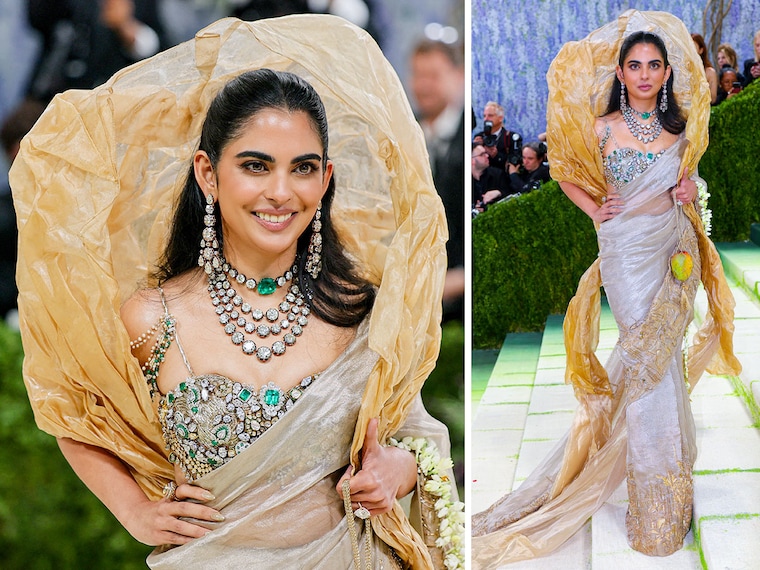
A Complete Breakdown: Every Element of Isha Ambani’s Met Gala Look
To understand why this look resonated globally, you have to slow it down — piece by piece. Nothing here was accidental. Every element balanced familiarity with intention.
The Saree: Fluid Gold, Not Loud Gold
Designed by Gaurav Gupta, the saree moves away from traditional stiffness and instead leans into fluidity.
- Fabric: A lightweight, sequinned textile that catches light without overwhelming it
- Tone: Muted gold — closer to heirloom than high-shine couture
- Texture: Subtle striping, almost invisible at a distance, rewarding a closer look
- Drape: Relaxed, unstructured — it falls naturally rather than being sculpted
This is important. At the Met Gala, gold is usually armor. Here, it behaves like memory.
It doesn’t dominate her presence — it follows her.

Photo: Dimitrios Kambouris/Getty Images for The Met Museum/Vogue
The Veil (Pallu): Soft Power, Not Drama
Instead of turning the pallu into a theatrical train (a common Met Gala move), it remains:
- Lightly draped over the shoulder
- Fluid and breathable
- Integrated into the saree rather than acting as a separate statement
There’s restraint here — and restraint is rare on that carpet.
The veil doesn’t perform. It belongs.
The Blouse & Jewellery: A Living Archive of the Ambani Legacy
This is where the look fundamentally shifts — from elegant to historic.
The blouse was not minimal. It was structurally built around jewellery.
- Construction: A heavily embellished bodice, encrusted with diamonds, emeralds, and polki
- Source: Drawn from the personal collection of Nita Ambani
- Stones: Old mine-cut diamonds, rare emeralds, and heritage polki
- Craft: Hand-set using traditional Indian techniques like kundan
Over 200+ diamonds were hand-sewn into the bodice alone, transforming it into couture that is literally embedded with family history
But that’s just the beginning.
Across the full look, the jewellery scaled to over 1,800 carats of diamonds and gemstones, making it one of the most opulent displays of heirloom jewellery at the Met Gala.
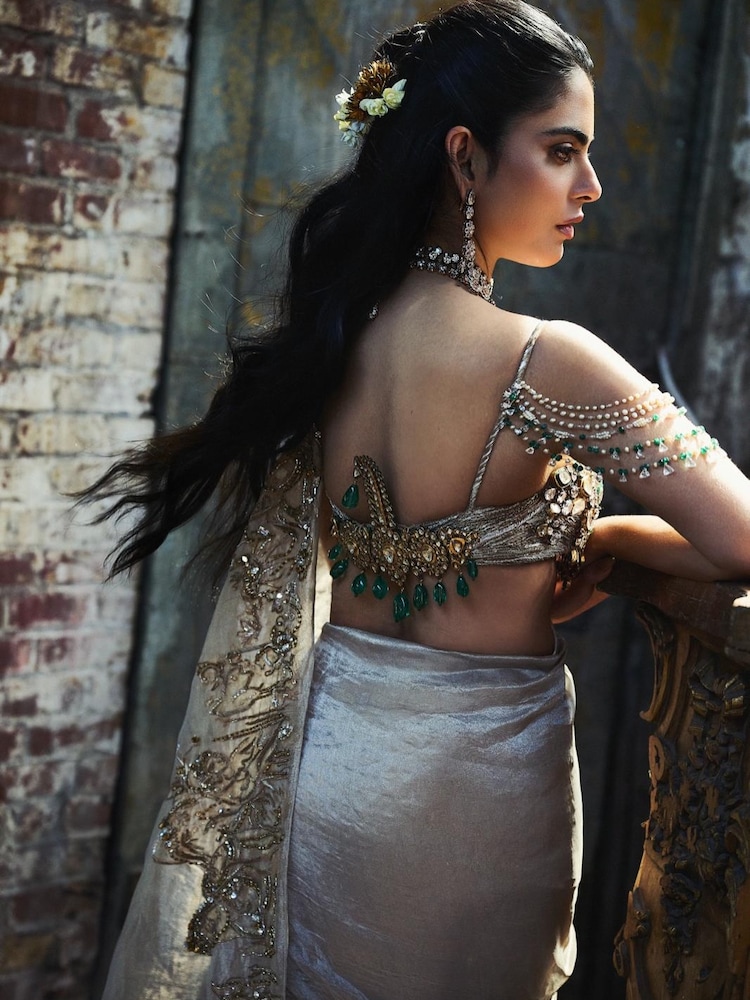
The Hair: The Gajra as an Emotional Anchor
The jasmine gajra is arguably the most powerful element of the entire look.
- Placement: Woven into a long braid
- Texture contrast: Soft white florals against sleek, dark hair
- Fragrance (implied): A sensory memory for anyone familiar with it
This isn’t styled as an accessory. It’s worn as ritual.
And that changes everything.
At the Met Gala, where most looks aim to impress, the gajra does something else — it connects.
The Mango (Aam): The Boldest Styling Choice
The sliced mango isn’t a prop. It’s a disruption. What appeared, at first glance, to be a playful styling choice — almost whimsical against the precision of diamonds and gold — was, in fact, something far more deliberate.
The mango was a 20-year-old sculpture by Subodh Gupta, one of India’s most influential contemporary artists. Known for transforming everyday Indian objects — steel tiffins, utensils, vessels — into museum-grade installations, Gupta’s work consistently blurs the line between the mundane and the monumental.
Placed within the context of the Met Gala, the mango does three things at once:
- Reclaims the ordinary: Mangoes are not rare in India — they are seasonal, messy, shared, and deeply emotional
- Elevates the everyday: Through Gupta’s lens, the aam becomes sculpture — worthy of galleries, not just kitchens
- Interrupts luxury codes: Surrounded by diamonds, it refuses hierarchy
This is where the look becomes intellectually sharp.
Because while others carried objects designed to signal status,
Isha carried something designed to mean something.
Styling That Refuses to Perform
Most Met Gala looks ask for attention.
This one doesn’t.
It assumes you’ll either understand it — or you won’t.
And that’s exactly why it works.
Frequently Asked Questions
Q: Who designed Isha Ambani's Met Gala dress?
A: Isha Ambani's Met Gala dress is a custom creation by Gaurav Gupta @gauravguptaofficial , the saree was envisioned as a fluid canvas, developed in collaboration with Swadesh @swadesh_online.
Q: What is the most expensive saree worn by Nita Ambani?
A: The most expensive saree worn by Nita Ambani is a sequinned Sabyasachi creation, which she wore in 2020 and later re-wore in 2022.
Q: What elements made Isha Ambani's Met Gala look unique?
A: Isha Ambani's look was unique due to its blend of traditional Indian elements like a gold saree, jasmine gajra, and a mango, which contrasted with the typical opulence of the Met Gala.
Q: What does the gajra symbolize in Indian culture?
A: In Indian culture, the gajra symbolizes everyday beauty and femininity, often worn by women as part of their daily routine.
Q: Why did Isha Ambani take aam (mango) in the Met Gala?
A: The aam (mango) was significant as it represented childhood and nostalgia, making a bold statement about Indian culture at a global event.
Q: How does Isha Ambani's fashion influence younger generations?
A: Isha Ambani's fashion influences younger generations by making traditional attire like sarees more relatable and accessible, encouraging a playful approach to heritage.


